Hardware-grade key storage protects users from device compromise—but in 2026, the majority of retail and institutional wallet losses come from social-engineered signing mistakes: address poisoning and forgotten unlimited ERC-20 approvals.
Any brand launching a white-label wallet must protect users before they tap Confirm. Here is how G-Wallet layers active pre-sign defenses on top of its native C++ vault.
1. Stopping Address Poisoning at the Send Screen
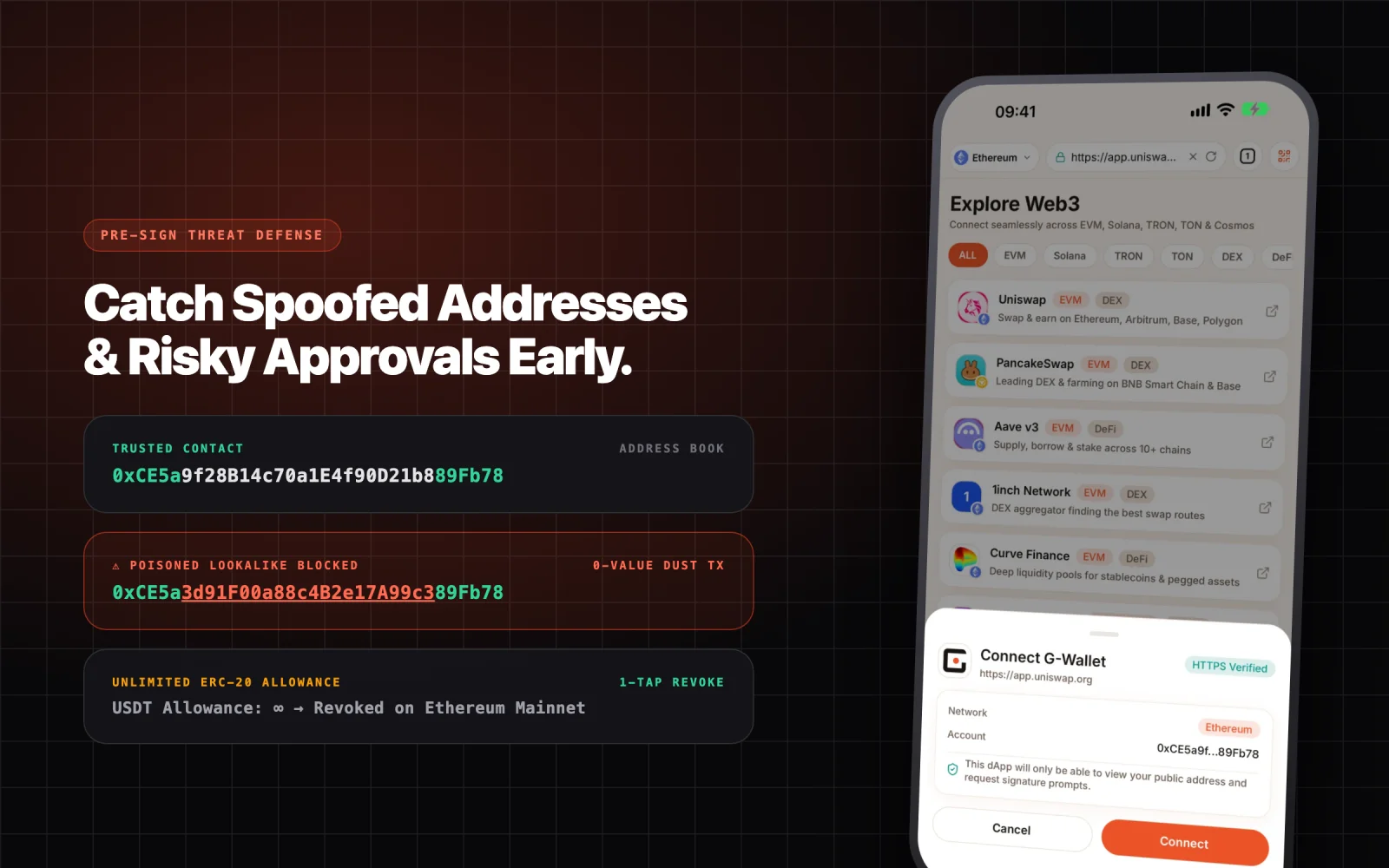
In an address poisoning attack, bots monitor the mempool for outbound transfers and immediately send a 0-value or dust transaction from a vanity address sharing the exact same first 4–6 and last 4–6 hex characters as your legitimate counterparty. Days later, a hurried user copies the poisoned address from transaction history and wires funds straight to the attacker.
G-Wallet’s Multi-Signal Poisoning Guard
- Middle-Byte Similarity Diffing: Before signing any Send transaction, G-Wallet compares the destination address against the user’s encrypted Address Book and recent legitimate counterparties. If prefix and suffix match while middle bytes diverge, the UI blocks one-tap confirmation with a high-contrast lookalike warning.
- Zero-Value Dust Filtering: Spam and 0-value spoof transfers are flagged and visually deprioritized in transaction history so users never accidentally copy a poisoned row.
- Chain-Validated Address Book: Trusted contacts are scoped per network (EVM, Solana, Bitcoin, TRON) with checksum validation to eliminate copy-paste errors.
2. Built-In ERC-20 Token Approval Scanner & 1-Tap Revoke
Interacting with DeFi protocols routinely asks users for approve(spender, MAX_UINT256)—granting a smart contract permanent, unlimited permission to move USDT, USDC, or WETH. If that protocol is exploited months later, drainers sweep every wallet that still holds an active allowance.
- G-Wallet includes a native Token Approval Manager directly inside the Swap & Security workflow, listing every active spender contract, token, and allowance cap.
- Users can revoke risky or unlimited allowances in 1 tap without leaving the mobile app or hunting for third-party web tools.
3. Verified HTTPS & Human-Readable dApp Connection Sheets
Inside G-Wallet’s native Web3 Browser (EIP-1193, Solana, TRON), every dApp connection modal explicitly surfaces the verified https:// origin, an HTTPS Verified badge, target chain, and exact signing scope before any provider permission is granted.
Pair active user protection with native Zero-Private-Key-in-JS C++ WalletCore security—explore the complete stack on G-Wallet.
License the complete iOS, Android & Gateway stack.
Turn-Key White-Label deployment or Full Source-Code IP ownership.